Faisal Mosque, Pakistan
 Kaaba, Mecca


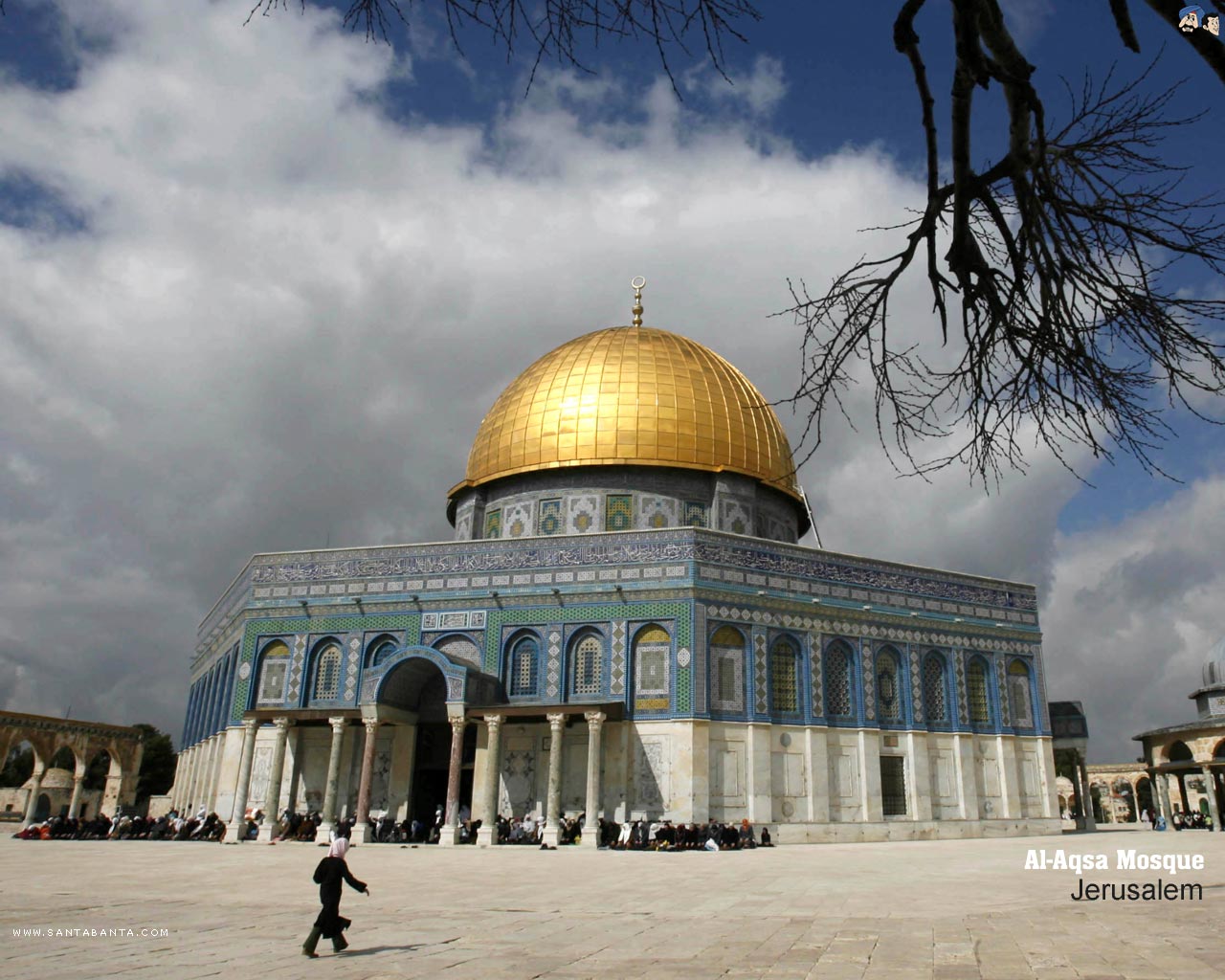
Al-Aqsa Mosque, Jerusalem
Blue Mosque, Mazar-I-Sharif

Faisal Mosque, Islamabad

Faisal Mosque, Islamabad

Grand Mosque, Touba

Umayyad Mosque, Syria

Jumeirah Mosque, Dubai

 In the middle: The prophet Muhammad's mausoleum in Medina; up to the right: Ali's mausoleum in Najaf; down to the right: Hasan's grave in the Baqi' cemetery in Medina; up to the left: Fatima's mausoleum [she was according to tradition buried in an unmarked grave in the Baqi' cemetery in Medina]; down to the left: Husain's mausoleum in Karbala. In the middle: The prophet Muhammad's mausoleum in Medina; up to the right: Ali's mausoleum in Najaf; down to the right: Hasan's grave in the Baqi' cemetery in Medina; up to the left: Fatima's mausoleum [she was according to tradition buried in an unmarked grave in the Baqi' cemetery in Medina]; down to the left: Husain's mausoleum in Karbala.Original: 23,3x16,4cm, purchased in Jerusalem, The Old City 25.06.99, Siv-Ellen Kraft.  Islam's three most sacred places: The sacred mosque in Mekka, The Prophet's mosque in Medina and Al-Aqsa mosque and The Dome of the Rock in Jerusalem. For a detailed discussion of this picture, see "Islams tre heilagstader" (only in Norwegian). Original: 36x25 cm, printed in Cairo. Purchased in Zaqaziq, Egypt October / November 1980 by Richard J. Natvig. |
 This narrative is one of the texts that Shia Muslims use in arguing that Ali is the rightful heir to leadership in the Muslim community, and the first Imam. Original: Small images, Ingvild Flaskerud, Qum 1999.  Ali with his sword Dhu 'l-Faqar. The Farsi text on the image encourages the viewer to learn from Ali's way of way of being. Ali is one of the great models for all Muslims, but for Shia Muslims in particular. Original: Small images, Ingvild Flaskerud, Qum 1999. 

|
 According to Iranian informants interviewed by Ingvild Flaskerud, such portraits should not be considered "real" portraits of the prophet Muhammad. The artists make these images on the basis of conventional ideas of the character of those personages depicted, in the same way it has been done with Biblical figures in European art. The text below the image is the shahada or Profession of faith: "There is no god but Allah, Muhammad is His messenger." Original: Purchased in Qum 1999 by Ingvild Flaskerud. 

 More common than portraits of the Prophet Muhammad are more or less schematic representations of his family or genealogical tree, or so-called "prophet trees", where the Prophet himself may be symbolized by a calligrahic representation of the name "Muhammad", and/or a rose. |

 This text is one of the most popular verses in the Koran, the Throne Verse (Sura 2, verse 255). As a heading, the "basmalla": "In the name of God, the Lord of Mercy, the Giver of Mercy", then follows the Koran verse: This text is one of the most popular verses in the Koran, the Throne Verse (Sura 2, verse 255). As a heading, the "basmalla": "In the name of God, the Lord of Mercy, the Giver of Mercy", then follows the Koran verse:"God: there is no god but Him, the Ever Living, the Ever Watchful. Neither slumber nor sleep overtakes Him. All that is in the heavens and in the earth belongs to Him. Who is there that can intercede with Him except by His leave? He knows what is before them and what is behind them, but they do not comprehend any of His knowledge except what He wills. His throne extends over the heavens and the earth; it does not weary Him to preserve them both. He is the Most High, the Tremendous." (From M. A. S. Abdel Haleem's translation, The Qur'an, Oxford University Press, 2004.) Original: 17x23 cm, produced by Muslim Information Services, 233 Seven Sisters Road, London N4.  The text on this picture is the same as on the previous picture. The text on this picture is the same as on the previous picture.Original: Small images, Ingvild Flaskerud, Qum 1999.  According to Muslim belief, the Koran is the actual words of God. Thus the Book partakes of God's sacredness. On the frontcover of the Koran on the picture, the title is Al-Qur'an al-karim - "The noble Koran", then follows a quote: "this is truly a noble Qur'an, in a protected Record that only the purified can touch" (Sura 56:77-79, from M. A. S. Abdel Haleem's translation, The Qur'an, Oxford University Press, 2004; the remainder of the text on the image is not readable). According to Muslim belief, the Koran is the actual words of God. Thus the Book partakes of God's sacredness. On the frontcover of the Koran on the picture, the title is Al-Qur'an al-karim - "The noble Koran", then follows a quote: "this is truly a noble Qur'an, in a protected Record that only the purified can touch" (Sura 56:77-79, from M. A. S. Abdel Haleem's translation, The Qur'an, Oxford University Press, 2004; the remainder of the text on the image is not readable).The admonition "that only the purified can touch" is often found under the title in Koran editions, and refers to Islam's rules of purification, which i.a. demands that the person reciting the Koran or touching the Koran, must be ritually purified. Original: 27x18 cm, printed in Italiy. Purchased in Zaqaziq in Egypt October / November 1980 by Richard J. Natvig. |


